Thursday, January 16, 2014
Torque Resource
This youtube video from Khan Academy is in introduction to torque, as he explains what torque is, the formulas, etc.
This video is very helpful in understanding torque because of the lecture style of teaching, along with the drawings and commentary provided. I also found that the examples he drew were very helpful in understanding torque, and even the bright colors helped me stay engaged in the material.

Sunday, January 12, 2014
Angular Momentum Resource
This youtube video is a good example of angular momentum presented in a fun way.
This video is very helpful in understanding angular momentum, because at first these kids are farther away from the axis of rotation, and then they move closer to the axis of rotation, resulting in a faster spinning of the merry go round.
Monday, December 9, 2013
Unit 3 Blog Reflection
The first thing we learned about this unit was Newton's 3rd Law, which states, Every action has an equal and opposite reaction. This was the starting base of our unit, in which we could refer back to in later works. Shortly after learning this, we learned about action/reaction pairs. An example of an action/reaction pair would be; Hand pushes apple downwards/Apple pushes hand upwards. When doing an action/reaction pair, all you need to do is switch the subject and the direction. One common mistake is that; Earth pushes apple down/apple pulls earth up is not an action/reaction pair because they would both have to be "pull" instead of "push" and then "pull."
 The next thing we learned about was the horse and buggy/tug of war problems. This was a challenge to me at first, but I feel slightly more comfortable now. The question of how does the buggy actually move was presented to us, and we were initially confused. We found out through drawings and explanations that the buggy moves because the horse pushes on the ground with more force than the buggy does. However, the forces are equal, because of Newton's 3rd Law. I will put the diagram/drawing of the horse and buggy problem here for reference. We also did a fun and helpful demonstration where we played tug of war, guys vs. girls, but all of the guys had socks on and the girls had shoes on. We tried our hardest to pull harder and win, but Newton's 3rd Law proved true once again. We ended up sliding past the line because the girls were able to apply more force to the ground.
The next topic we learned about was forces in perpendicular directions and vectors. I found this to be a fun section and thought it was relatively easy. Vectors are basically the same thing as forces in perpendicular directions, in which one force could be going up and the other to the right. When drawing vectors, the first thing you do is draw lines equal and opposite to the two original lines, so that it forms some form of a parallelogram. Next, you draw a line from one corner to the other, and that is the actual direction the object will go. If solving mathematically, one can use the formula a^2+b^2=c^2.
Gravity and Tides followed vectors, and the main formula we learned was the universal gravitational force equation, which is F=G(m1m2/d^2). When solving an equation using this equation, it could seem really hard, but as long as you separate the numbers it is not that hard. The main formula for tides was F=1/d^2. The reason tides work the way they do is because the distance from one side of the earth to the moon is smaller, and since we know force is inversely proportional to distance, then that side will have a greater force acting upon it, while the opposite side has a greater distance, resulting in a smaller force. So the reason for tides is the difference in force by the opposite sides of the earth.
 The relationship between momentum and impulse topic had many equations to go along with it. The equation for momentum is P=mv, where P is momentum. The ∆P=Pfinal-Pinitial, and the ∆P is the same regardless if you stop quickly/slowly. Impulse is J, and the equation is J=Forcex∆t, so J=∆P. The big question we asked in this section was, why do airbags keep us safe? The answer is that the airbag increases the time of impulse, therefore the force on you is less, and leading to less injury. Big force=small time/small force=big time.
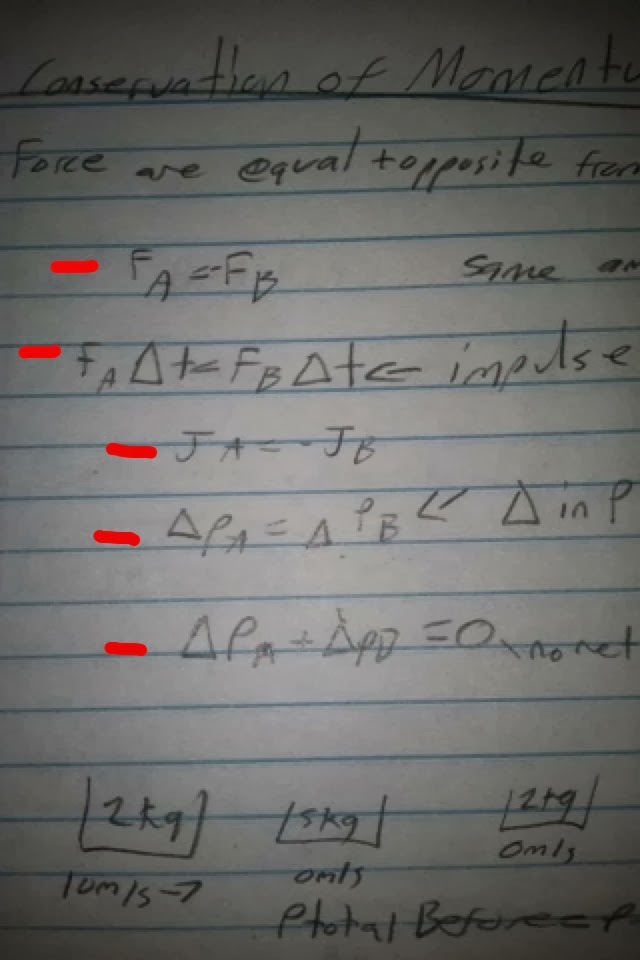
In the conservation of momentum, the forces are equal and opposite from Newton's 3rd Law. Conserved momentum means not changed, and there are 5 different equations to remember for this. They will be written out in a picture next to this.
I found it difficult remembering all of the different equations for each section. I overcame these problems by reviewing the videos, my notes, and my quizzes from earlier. I feel as if I tried pretty hard this unit, however I wish that some of my quiz grades were better. Whether it was not studying enough or stupid mistakes, I will always try to do better on future quizzes. I will do this by studying more and checking over my work.
I made many connections to real life situations throughout this unit. Momentum and impulse were relevant in the egg toss, and as well as skateboarding and throwing a football.
 The next thing we learned about was the horse and buggy/tug of war problems. This was a challenge to me at first, but I feel slightly more comfortable now. The question of how does the buggy actually move was presented to us, and we were initially confused. We found out through drawings and explanations that the buggy moves because the horse pushes on the ground with more force than the buggy does. However, the forces are equal, because of Newton's 3rd Law. I will put the diagram/drawing of the horse and buggy problem here for reference. We also did a fun and helpful demonstration where we played tug of war, guys vs. girls, but all of the guys had socks on and the girls had shoes on. We tried our hardest to pull harder and win, but Newton's 3rd Law proved true once again. We ended up sliding past the line because the girls were able to apply more force to the ground.
The next topic we learned about was forces in perpendicular directions and vectors. I found this to be a fun section and thought it was relatively easy. Vectors are basically the same thing as forces in perpendicular directions, in which one force could be going up and the other to the right. When drawing vectors, the first thing you do is draw lines equal and opposite to the two original lines, so that it forms some form of a parallelogram. Next, you draw a line from one corner to the other, and that is the actual direction the object will go. If solving mathematically, one can use the formula a^2+b^2=c^2.
Gravity and Tides followed vectors, and the main formula we learned was the universal gravitational force equation, which is F=G(m1m2/d^2). When solving an equation using this equation, it could seem really hard, but as long as you separate the numbers it is not that hard. The main formula for tides was F=1/d^2. The reason tides work the way they do is because the distance from one side of the earth to the moon is smaller, and since we know force is inversely proportional to distance, then that side will have a greater force acting upon it, while the opposite side has a greater distance, resulting in a smaller force. So the reason for tides is the difference in force by the opposite sides of the earth.
 The relationship between momentum and impulse topic had many equations to go along with it. The equation for momentum is P=mv, where P is momentum. The ∆P=Pfinal-Pinitial, and the ∆P is the same regardless if you stop quickly/slowly. Impulse is J, and the equation is J=Forcex∆t, so J=∆P. The big question we asked in this section was, why do airbags keep us safe? The answer is that the airbag increases the time of impulse, therefore the force on you is less, and leading to less injury. Big force=small time/small force=big time.
In the conservation of momentum, the forces are equal and opposite from Newton's 3rd Law. Conserved momentum means not changed, and there are 5 different equations to remember for this. They will be written out in a picture next to this.
I found it difficult remembering all of the different equations for each section. I overcame these problems by reviewing the videos, my notes, and my quizzes from earlier. I feel as if I tried pretty hard this unit, however I wish that some of my quiz grades were better. Whether it was not studying enough or stupid mistakes, I will always try to do better on future quizzes. I will do this by studying more and checking over my work.
I made many connections to real life situations throughout this unit. Momentum and impulse were relevant in the egg toss, and as well as skateboarding and throwing a football.
Thursday, November 14, 2013
Tides Resource
This youtube video basically explains tides along with the universal gravitational force formula and how it is related.
This video is very helpful in understanding tides because of the drawings and explanation throughout the video. I found that when he talked about how the universal gravitational force formula and how it actually related to tides and the pictures he was drawing was very helpful in understanding this concept.
Thursday, October 31, 2013
Unit 2 Blog Reflection
 The first
thing we learned about in this unit was Newton’s Second Law of motion, which
states that acceleration is inversely proportional to mass and directly
proportional to force. Newton’s 2nd law written as an equation is
a=(fnet/mass). We then conducted a lab in which we tested Newton’s 2nd
law by using a rolling cart and a pulley system. After the lab, we then learned
about skydiving and falling through the air. I learned that when falling with
air resistance, F-air (force of air) is directly proportional to speed and
surface area. This means that if the speed or surface increases, then the f-air
will also increase. After falling for a certain amount of time, the skydiver
will reach a point called terminal velocity (constant velocity) where they
remain at a constant velocity. Next, we learned about free fall, which is falling
without air resistance. The force of gravity is the only force affecting
anything in free fall, where gravity is a constant 9.8m/s^2. In this case the
equation a=(f-net)/(mass) changes to a=g because the force of gravity on mass
is also known as weight. The equation to change weight to mass, and vice versa,
is w=mg. To find how high, d=1/2gt^2 is the right equation, while how fast
would be v=gt. Similar to free fall, we learned about throwing things straight
up as well. The acceleration acting on an object thrown up is always 10m/s^2,
and that drawing a picture of the path of the object is very helpful. The last
thing we learned about was falling and throwing things up at an angle. The most
important thing we learned was that the only thing that determines the time in
the air is the vertical height. An object falling at an angle will take a
parabolic path to the ground, and the horizontal force is always constant. When
an object is thrown at an angle at the top of it’s path, it still has a
horizontal force acting upon it.
The first
thing we learned about in this unit was Newton’s Second Law of motion, which
states that acceleration is inversely proportional to mass and directly
proportional to force. Newton’s 2nd law written as an equation is
a=(fnet/mass). We then conducted a lab in which we tested Newton’s 2nd
law by using a rolling cart and a pulley system. After the lab, we then learned
about skydiving and falling through the air. I learned that when falling with
air resistance, F-air (force of air) is directly proportional to speed and
surface area. This means that if the speed or surface increases, then the f-air
will also increase. After falling for a certain amount of time, the skydiver
will reach a point called terminal velocity (constant velocity) where they
remain at a constant velocity. Next, we learned about free fall, which is falling
without air resistance. The force of gravity is the only force affecting
anything in free fall, where gravity is a constant 9.8m/s^2. In this case the
equation a=(f-net)/(mass) changes to a=g because the force of gravity on mass
is also known as weight. The equation to change weight to mass, and vice versa,
is w=mg. To find how high, d=1/2gt^2 is the right equation, while how fast
would be v=gt. Similar to free fall, we learned about throwing things straight
up as well. The acceleration acting on an object thrown up is always 10m/s^2,
and that drawing a picture of the path of the object is very helpful. The last
thing we learned about was falling and throwing things up at an angle. The most
important thing we learned was that the only thing that determines the time in
the air is the vertical height. An object falling at an angle will take a
parabolic path to the ground, and the horizontal force is always constant. When
an object is thrown at an angle at the top of it’s path, it still has a
horizontal force acting upon it.
The main
thing that I have found difficult in this unit is remembering all of the
different equations and what they correspond to. Especially since there are two
equations when solving for the vertical and another for the horizontal. I
overcame these difficulties by constant review and making sure I was correct
each time I solved a problem using one of the equations. I also found that some
of the equations are self explanatory, however some of them just require
memorization to what they correspond to.
I think
I’ve had a solid effort towards class, homework, activities, blog posts, etc. I
feel that this really helps in learning and understanding the material, because
the effort I put in helps in understanding the notes and other things during
class. My persistence is also a key factor in this class, because not giving up
is important when learning new material, even if it’s hard. Having
self-confidence in yourself is also important because if you’re not confident
than you might not ever ask a question that you don’t understand, which will
most likely lead to getting it wrong on the test. Lastly, collaborating with
your group members is important because you need to split the work up evenly,
and they can help you if you need it.
My goal for
next unit is to do even better on both open and closed note quizzes, because
they are relatively easy points if you study/go over your notes every night. I
plan to review my notes more, and also pay more attention when watching videos
and taking notes.
One
connection I can make is throwing things at an angle, because I often will
throw a football, Frisbee, or any other type of ball. It is interesting to
think about the acceleration and velocity the ball has when I throw it and when
it’s in the air.
Tuesday, October 22, 2013
Falling Through the Air Resource
In this video, several crazy base jumpers jump off massive cliffs and freefall for up to 28 seconds! They simply jump off and then sort of glide until they need to pull their parachute.
This relates to freefall quite literally, in that they are actually in freefall for almost half a minute, which is interesting to see because of how they accelerate at first but then they hit terminal velocity. This video is a great visual explanation of freefall, as well as a very exciting and cool video as well.
Sunday, October 13, 2013
Newton's Second Law Resource
In this video titled "What in the World is Newton's Second Law of Motion," physics is applied to a very common sport, football. Taking place during the practice of a pre-season football team, Newton's Second Law of motion is applied to a football kicker.
Some specific things in this video that were particularly helpful were that they had a mix of examples, explanations, and writing all about Newton's Second Law. There was a good use of pausing right as the kicker would kick the ball so that they could explain exactly what happens as he kicks it. The professor also explained very well that the acceleration will increase as a result of the force increasing, as long as the mass is constant.
Subscribe to:
Posts (Atom)